AI-Powered DevOps Pipelines: Automating Code Review and Testing
estimated read time: 5 minutes
Artificial intelligence has been a major theme in software development for several years now, with tools such as GitHub Copilot helping developers write code more efficiently. In this post, I'll explore the potential of applying this approach to continuous integration within the DevOps arena.
Introduction
AI has the potential to revolutionise software development by automating routine tasks and improving the accuracy of complex ones. Within DevOps, AI could enhance continuous integration processes, making them faster, more efficient, and more secure. By leveraging AI, teams can save time and resources whilst delivering high-quality software more quickly.
Pair Programming
Pair programming is a popular practice in software development, where two programmers work together on a single task—coding, debugging, or designing. The benefits include improved code quality, reduced time to completion, and knowledge sharing. However, pairing can be challenging, particularly when developers have different skill levels or working styles.
AI can assist by providing real-time feedback on code quality, suggesting improvements, and helping to resolve errors. An AI-powered tool can analyse code from both programmers, identify potential issues, and suggest solutions. This saves time and reduces the likelihood of bugs in the final product.
Additionally, AI could help pair programmers find suitable partners by analysing working styles, experience, and language proficiency. As AI continues to advance, it has the potential to transform pair programming into something more efficient and productive than ever before.
On the surface, this might seem comparable to tools we've had in IDEs for some time. The difference is that rather than being another static analysis tool, AI would act as a third member—a trio powerhouse to what was previously a duo engagement.
Test-Driven Development On-Demand
Imagine if code could be generated by AI based on a clear TDD test scenario.
AI-powered tools can analyse a Given-When-Then (GWT) statement and generate a corresponding code snippet, saving developers the time and effort of writing it manually. The algorithm can learn from existing code repositories, identify patterns, and generate code that adheres to best practices and coding standards. Furthermore, AI can suggest alternative implementations, allowing developers to compare and choose the most efficient solution.
This could help ensure that test cases are comprehensive, covering all possible scenarios and leading to improved quality and reliability.
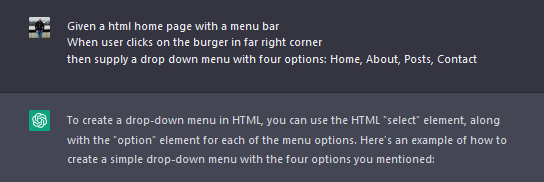
GIVEN user opens the splash page
WHEN they click on the main menu burger in the far right corner
THEN a menu appears with the options:
- Home
- About
- Posts
- Contact
Testing GWT Context with OpenAI
<!DOCTYPE html>
<html>
<head>
<title>My Website</title>
<style>
.dropbtn {
display: inline-block;
background-color: #f1f1f1;
color: #555;
padding: 12px;
font-size: 16px;
border: none;
cursor: pointer;
}
.dropdown-content {
display: none;
position: absolute;
z-index: 1;
}
.dropdown-content option {
color: black;
padding: 12px 16px;
text-decoration: none;
display: block;
}
</style>
</head>
<body>
<nav>
<div class="dropdown">
<button class="dropbtn">☰</button>
<div class="dropdown-content">
<a href="#">Home</a>
<a href="#">About</a>
<a href="#">Posts</a>
<a href="#">Contact</a>
</div>
</div>
</nav>
</body>
</html>
In this example, the nav element contains a div with class dropdown, which holds a button displaying the hamburger icon (☰). The dropdown-content div is hidden by default using display: none.
To show the menu when the user clicks the button, you can use JavaScript to toggle the display property:
$(document).ready(function () {
  $(".dropbtn").click(function () {
    $(".dropdown-content").toggle();
  });
});
This isn't perfect—far from it—but it highlights how the model could be used to create development tools that add a 10x multiplier, whilst keeping the human developer in the driving seat to audit the AI's work.
Code Maturity
Static code analysis is a well-established practice for checking code quality and security. However, one of AI's strengths might lie in refactoring code rather than creating new code. Imagine a pipeline that not only reviewed proposed changes but also suggested ways to optimise them.
This could be achieved by leveraging AI algorithms that analyse code structure, performance characteristics, and suggest refactoring opportunities.
Security Scanning
Another potential use of AI in DevOps is security scanning. An AI-powered security bot could act as a gatekeeper in the CI pipeline, ensuring all security considerations have been met. It could check dependencies, validate proposed infrastructure changes, and perform complex security analysis. The key advantage is that AI can understand the context of a change, providing more accurate and relevant security insights.
Case Studies
Several real-world examples demonstrate AI being used in DevOps. Google developed TensorFlow to help developers train machine learning models more efficiently. H2O.ai uses AI to automate feature engineering, enabling data scientists to build and deploy models faster. In 2020, OpenAI released the public beta of ChatGPT, which has since been integrated into Bing Search—it's only a matter of time before we see it in Azure DevOps. Amazon and Google are expected to follow with their own offerings.
Conclusion
AI has the potential to revolutionise DevOps by automating routine tasks, improving the accuracy of complex tasks, and enhancing continuous integration. By leveraging AI, teams can deliver high-quality software more efficiently and securely. As the technology continues to advance, we can expect to see even more innovative applications in the future.
That said, the cynic in me suspects that whilst the technology is approaching maturity, adoption will require cultural change, discipline, and openness to new practices. Frustratingly, these are purely human factors that cannot be injected without resistance. It will take time—and fresh faces—to adopt these practices. In an industry that doubles in size every 18 months, one hopes we'll see meaningful change within the next two years or so.
Related Articles
My AI Wrote a Keylogger Into My Keyboard Driver. Another AI Caught It.
While building a Rust driver for my Razer keyboard, the AI I was working with wrote a udev rule that let any program I ran read my keystrokes, underneath Wayland. It even told me it was safe. A second AI caught it past midnight. How it happened, how I proved it, why the first fix didn't work, and a script to check your own machine.
Blocking AI Scrapers: Protecting Your Content from Unauthorised Training Data
68% of my blog traffic this week was AI scrapers harvesting content for training data. Here's how I'm blocking OpenAI, Anthropic, Meta, and other AI crawlers — and why you should too.
Automating Cloudflare DNS Updates from a Kubernetes CronJob
When my ISP started rotating my residential IP weekly, I stopped updating Cloudflare manually and built a Kubernetes CronJob that does it automatically every 15 minutes.
k3s HA on Raspberry Pi: Zero-Downtime Cluster in 45 Minutes (Multi-Master + MySQL)
Stop single-point failures. Build a production-grade k3s cluster with 3 master nodes, external MySQL, and load balancing—all on budget Pi hardware. Step-by-step guide with troubleshooting.